You don’t need to be a scientist or a financial expert to understand why measuring carbon
matters. Here’s what it is, why it’s become such a big deal, and what it means for everyday
life.
We hear a lot about “carbon” these days — in the news, on product packaging, in company
reports. But what does it actually mean to “count” carbon? And why do businesses,
governments, and investors care so much about it right now?
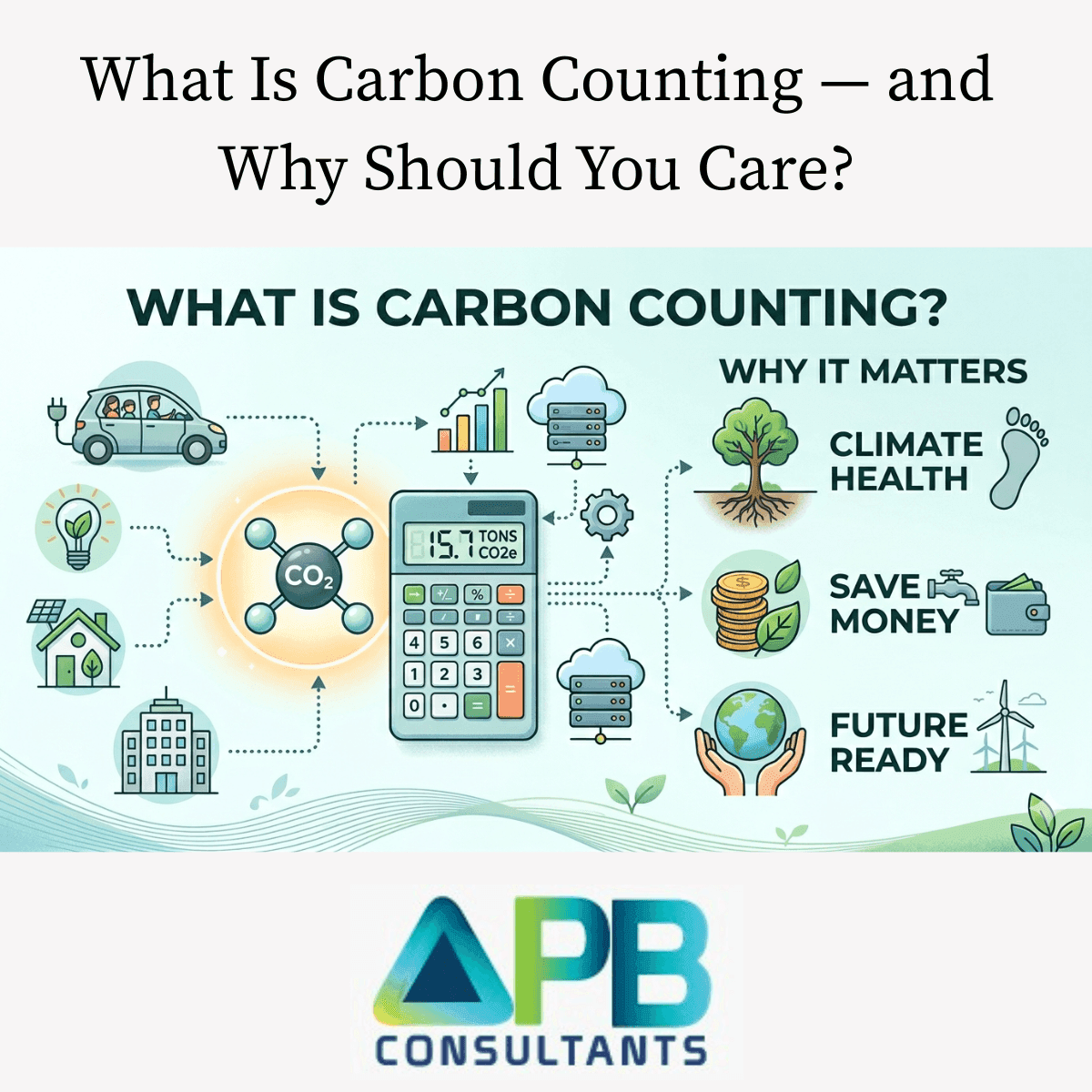
The short answer: carbon counting (or “carbon quantification”) is simply the process of
measuring how much greenhouse gas a company, building, or product puts into the
atmosphere. Think of it like a calorie count — but for pollution.
Simply: Greenhouse gases, mainly carbon dioxide (CO₂) trap heat in the atmosphere. The
more we emit, the warmer the planet gets. Measuring emissions is the first step to reducing
them.
Where Do Emissions Come From?
Scientists and regulators use a simple system to sort emissions into three “scopes”.
| Scope | What it covers | Everyday example |
|---|---|---|
| Scope 1 | Pollution the company creates directly | A factory burning gas to run its machines |
| Scope 2 | Pollution from the energy the company buys | Electricity is used to light and heat the office |
| Scope 3 | Everything else up and down the supply chain | Shipping products to customers, employees flying for work, waste from old products |
Scope 3 is often the trickiest — and the biggest. Studies suggest it can make up around
three-quarters of a company’s total emissions. That’s why it’s important to measure the full
picture, not just what happens inside a company’s four walls.
Why Is Everyone Talking About This Now?
Carbon counting isn’t new — but it has moved from a niche concern to a global priority very
quickly. Here’s why.
- Governments are making it the law. In 2023, an international body called the ISSB
(International Sustainability Standards Board) published new rules — known as IFRS S2 — that
require companies to report their carbon emissions alongside their financial results. Countries
including the UK, Australia, Singapore, Canada, and many others are now turning these rules
into national law. - Carbon pollution has a price tag. In Europe, companies must buy “permits” to pollute.
These are traded on the EU Emissions Trading System (ETS) — the world’s oldest and largest
carbon market, running since 2005. In 2024, the price of one permit sat around €65 per tonne
of CO₂. This creates a very real financial cost for polluting businesses. - Investors are paying attention. Banks, pension funds, and big investors want to know if the
companies they back are exposed to carbon risk. An asset that pumps out a lot of emissions Investors are paying attention. Banks, pension funds, and big investors want to know if the
companies they back are exposed to carbon risk. An asset that pumps out a lot of emissions
What Does This Have to Do with Valuation?
When we value a business or a property, we’re trying to figure out what it’s worth today —
and what it might be worth in the future. Carbon exposure now affects both.
Imagine two factories doing the same thing. One has measured its emissions, reduced them
where it can, and has clean data ready to show investors. The other has never been
concerned. Which one would you pay more for? Almost certainly the first one — because it
carries less risk and uncertainty.
“Carbon data is becoming like a credit score for businesses — it shapes what you can
borrow, how much you pay for it, and what someone will pay to buy you.”
Here are the four main ways carbon affects the value:
- Higher borrowing costs. Banks are starting to charge more to lend money to high-polluting
businesses. If a company can’t prove its emissions are under control, it may find finance
harder and more expensive to get. - Assets become worthless early. A coal plant or a gas-guzzling fleet might have been worth a
lot ten years ago. But as climate rules tighten, some assets lose their value well before they
wear out. Experts call this “stranded asset” risk. - Tougher deal negotiations. When one company buys another, it will now often check the
carbon footprint as part of its due diligence, the same way it checks the accounts. Poor
carbon data means lower offers or deals falling through. - Investor preference for clean assets. Many of the world’s biggest pension funds have
promised to reach “net zero” emissions across their investments. That means they actively
look for lower-carbon businesses to back and pay more for them.
Does It Work the Other Way Too?
Yes. And this is the part that often gets overlooked.
Businesses that have genuinely cut their emissions — by using renewable energy, reducing
waste, or cleaning up their supply chains — often run more efficiently too. Lower energy
bills. Fewer regulatory headaches. Better access to funding. These things add real value, and
a thorough carbon assessment helps us find and prove that value.
Good to know: If a business has done the hard work of reducing its carbon footprint, proper
measurement is the only way to make sure that effort is reflected in its valuation. Without the
data, the work is invisible.
Why Data Quality Matters
Not all carbon data is equal. There’s a big difference between a rough estimate a company
has produced itself and figures that have been independently checked and verified.
The gold standard is the GHG Protocol — a global rulebook for measuring emissions, used
by 92% of Fortune 500 companies. When a company’s carbon data has been measured using the GHG Protocol and verified by an independent expert, it carries far more weight
with investors, buyers, and lenders than a rough self-reported number.
Think of it like getting a building surveyed before you sell it. You could just guess what
condition it’s in — but a professional survey gives buyers confidence and helps you get the
best price.
What Does This Mean for You?
Whether you own a business, invest in property, or simply want to understand the world
around you, carbon counting is becoming part of everyday financial life. Here’s a quick
summary of what to take away:
✔ Carbon counting is just measuring pollution. Companies track how much greenhouse
gas they produce — directly, from energy use, and across their supply chains.
✔ The rules are changing fast. Governments around the world are making carbon
disclosure compulsory. This isn’t a future trend — it’s already happening.
✔ It affects what things are worth. High-carbon businesses face higher costs, tougher
borrowing, and lower sale prices. Low-carbon businesses attract better investors and
better deals.
✔ Good data is an asset. If a business has reduced its emissions, having verified data is the
only way to prove it — and benefit from it financially.
✔ You don’t need to be an expert. That’s what valuation and climate consultants are for.
Our job is to translate complex carbon data into clear financial insight.
Want to understand what carbon exposure means for your business or assets? Our team explains it simply — no jargon, no acronyms, just clear answers. Contact us!