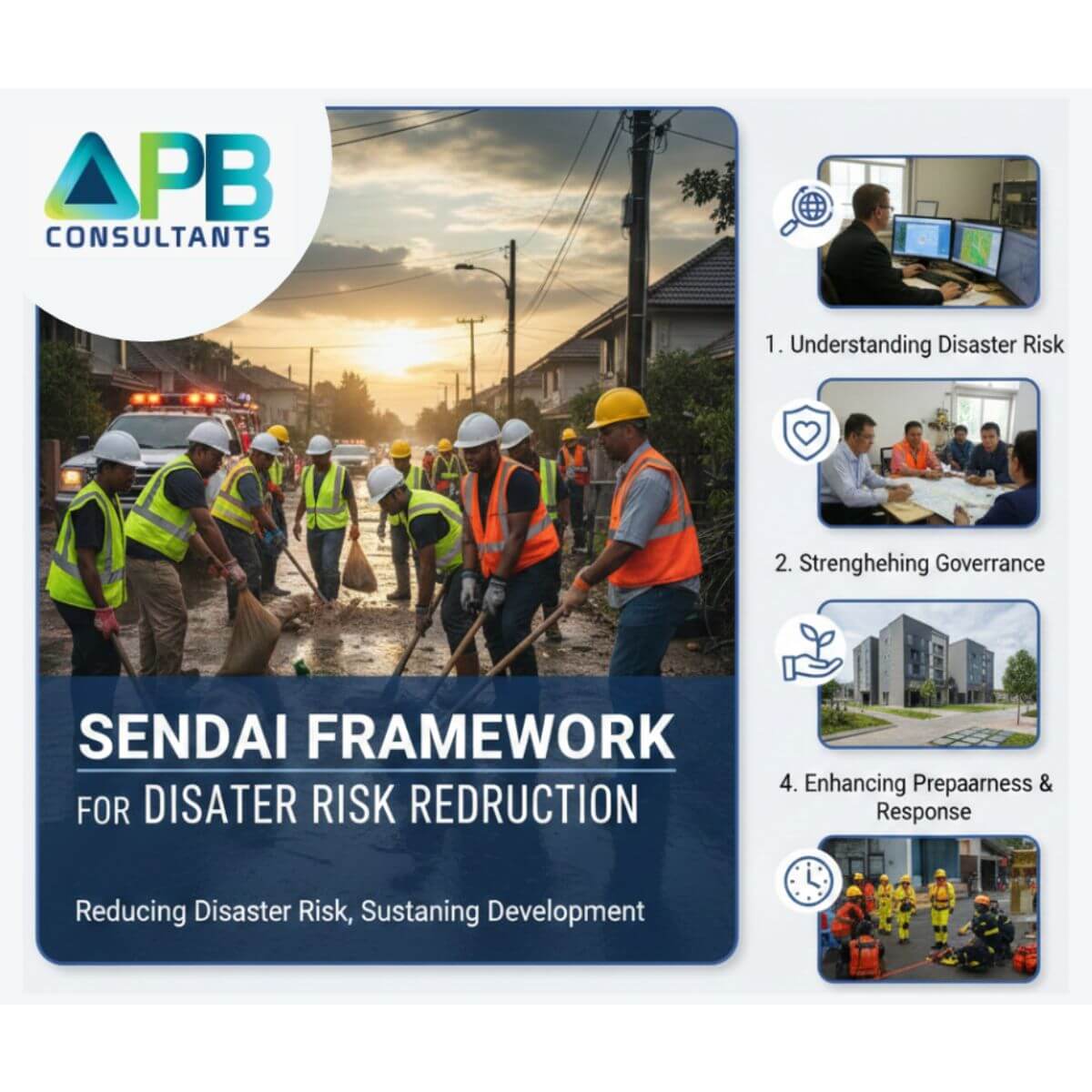
As climate change intensifies, vulnerable countries face unprecedented disaster risks. Sri Lanka’s devastating experience with Cyclone Ditwah in November 2025—killing nearly 500 people and causing economic losses exceeding USD 6-7 billion—underscores the urgent need for comprehensive disaster risk reduction (DRR) strategies. The Sendai Framework for Disaster Risk Reduction provides a global blueprint for building resilience in nations most vulnerable to climate-related disasters.
Understanding the Sendai Framework
Adopted in 2015 at the Third UN World Conference on Disaster Risk Reduction in Sendai, Japan, the Sendai Framework for Disaster Risk Reduction 2015-2030 represents the first major agreement of the post-2015 development agenda. It provides Member States with concrete actions to protect development gains from disaster risk, working hand-in-hand with the Paris Agreement on Climate Change and the Sustainable Development Goals.
Four Priority Areas for Action
The Framework identifies four interconnected priorities:
- Understanding Disaster Risk: Risk management must be based on comprehensive understanding of disaster risk in all dimensions—vulnerability, capacity, exposure, hazard characteristics, and environmental factors.
- Strengthening Disaster Risk Governance: Effective governance at national, regional, and global levels is vital, requiring coherent frameworks of laws, regulations, and public policies that define roles and responsibilities.
- Investing in Disaster Risk Reduction for Resilience: Public and private investment in prevention and reduction through structural and non-structural measures enhance economic, social, health, and cultural resilience.
- Enhancing Disaster Preparedness for Effective Response: Strengthening preparedness and ensuring response and recovery capacities at all levels, with recovery phases presenting opportunities to ‘Build Back Better.’
The Framework also establishes seven ambitious global targets for 2030, including substantially reducing disaster mortality, decreasing the number of affected people, reducing direct economic losses relative to GDP, minimizing infrastructure damage, increasing countries with national DRR strategies, enhancing international cooperation, and expanding access to multi-hazard early warning systems.
Sri Lanka: Climate Vulnerability in Focus
Sri Lanka exemplifies the challenges facing climate-vulnerable nations. Ranked as the fourth most climate-affected country in 2016 by the Global Climate Risk Index, Sri Lanka faces interconnected climate hazards where 96% of disasters are climate-related, including flooding, landslides, extreme winds, and drought. Over 600,000 Sri Lankans are affected by natural disasters annually on average, while 48.8% of the population lacks adequate disaster preparedness. Furthermore, 25% of the population resides in coastal areas vulnerable to sea-level rise.
The country experiences a paradoxical cycle of extremes—alternating floods and droughts within short timeframes, often affecting the same districts. This pattern of recurring disasters gradually erodes household coping strategies and the capacity to return to normalcy, creating a downward spiral of vulnerability.
Lessons from Cyclone Ditwah
The devastating impact of Cyclone Ditwah in November 2025 exposed critical weaknesses in Sri Lanka’s disaster preparedness infrastructure. The cyclone triggered widespread floods and 215 landslides, affecting over 1.4 million people and revealing systemic vulnerabilities: flood management systems designed 50 years ago remain largely unchanged despite poor urban planning and accelerating climate change; urban development has encroached on wetlands and natural flood barriers; reliance on obsolete hydrological data persists; and early warning systems inadequately integrate multiple hazards and long-range scenario modeling.
Building Climate Adaptation and Resilience
Effective climate adaptation requires a multi-dimensional approach addressing both immediate disaster response needs and long-term resilience building. For countries like Sri Lanka, this means transforming planning, investment, and governance in the face of escalating climate risks.
Integrated Water Resource Management
Water security lies at the heart of Sri Lanka’s climate resilience challenge. The country’s traditional cascade system of tanks and canals historically provided efficient water management. Today, around one-third of the population is vulnerable and deprived in water sources, with communities in the dry zone chronically struggling with water scarcity.
Ecosystem-Based Adaptation
Natural ecosystems provide critical disaster risk reduction services. Mangroves protect coastlines from storm surge, forests prevent landslides, and wetlands absorb floodwaters. The World Bank’s Ecosystems Conservation and Management Project demonstrates the value of protecting natural resources not only for biodiversity but for economic resilience. Nature-based solutions like mangrove restoration and coral reef protection can safeguard coastlines while providing co-benefits for livelihoods and food security.
Infrastructure Resilience
Critical infrastructure must be designed for future climate conditions, not historical patterns. This includes updating flood maps to capture compound hazards (rainfall, river flow, storm surge, and sea-level rise), redesigning drainage and river management systems for future rainfall intensities, implementing strict science-based construction regulations, and maintaining reservoirs and early warning systems through dedicated budget allocations.
Community-Based Resilience
Local communities are the first responders in disasters and must be empowered with resources, knowledge, and decision-making authority. Community-based disaster risk reduction integrates traditional knowledge systems with modern technology and institutional expertise. In multi-ethnic, post-conflict societies like Sri Lanka, sensitivity to ethno-political dynamics is imperative across all phases of disaster management: preparedness, emergency response, and post-disaster recovery.
The Path Forward: Key Recommendations
For vulnerable countries like Sri Lanka, the path to resilience requires systematic action:
- Develop comprehensive national DRR strategies aligned with Sendai Framework targets, integrating climate change projections and incorporating both top-down policy frameworks and bottom-up community needs.
- Invest in data and risk assessment by building disaster loss databases, developing updated hazard maps, and conducting probabilistic risk assessments to inform evidence-based decision-making.
- Strengthen early warning systems that are multi-hazard, reach the last mile, and ensure vulnerable communities receive actionable information in time to respond.
- Mainstream resilience in development planning by integrating disaster risk considerations into all major development projects, infrastructure investments, and land use decisions.
- Protect and restore natural ecosystems recognizing the disaster risk reduction services provided by forests, wetlands, mangroves, and coastal ecosystems.
- Build institutional capacity by training government officials, planners, and community leaders in disaster risk assessment, management, and resilience building.
- Regional cooperation to share knowledge, coordinate policies, and support mutual assistance among countries facing similar climate challenges.
Conclusion
The convergence of climate change and development pressures creates unprecedented challenges for vulnerable nations. Yet, as the Sendai Framework demonstrates, resilience is achievable through systematic action. For Sri Lanka and similar countries, development and disaster risk reduction are inseparable. The devastation of Cyclone Ditwah need not be repeated.
With systematic application of the Sendai Framework’s principles—understanding risk, strengthening governance, investing in resilience infrastructure, and enhancing preparedness—vulnerable nations can break the destructive cycle of disasters. The path forward requires courage to confront current vulnerabilities, wisdom to learn from both traditional knowledge and modern science, and determination to make necessary investments for a resilient future.
As the Sendai Framework’s timeline reaches its midpoint and the climate crisis intensifies, the imperative is clear: vulnerable nations must act now to build the resilient future their populations deserve. The tools, frameworks, and knowledge exist—what remains is the collective will to use them effectively.
References
1. United Nations Office for Disaster Risk Reduction (UNDRR). (2015). Sendai Framework for Disaster Risk Reduction 2015-2030. Geneva: UNDRR.
2. United Nations Office for Disaster Risk Reduction (UNDRR). (2025). Global Assessment Report on Disaster Risk Reduction 2025: Resilience Pays. Geneva: UNDRR.
3. World Bank. (2025). Sri Lanka Cyclone Ditwah: Rapid Damage and Needs Assessment. Washington, DC: World Bank Group.
4. Global Climate Risk Index. (2016). Who Suffers Most from Extreme Weather Events? Germanwatch.
5. Green Climate Fund. (2020). Climate Resilient Integrated Water Management Project – Sri Lanka. Songdo: GCF.
6. World Bank. (2023). Ecosystems Conservation and Management Project (ESCAMP) – Sri Lanka. Washington, DC: World Bank Group.
7. Asian Development Bank. (2021). Climate Risk Country Profile: Sri Lanka. Manila: ADB.
8. United Nations Development Programme (UNDP). (2022). Disaster Risk Reduction and Climate Change Adaptation in Sri Lanka. Colombo: UNDP Sri Lanka.